Why are Teslas the safest cars in the world?
Featured image: tesla.com
Seriously, why are Teslas the safest cars in the world?
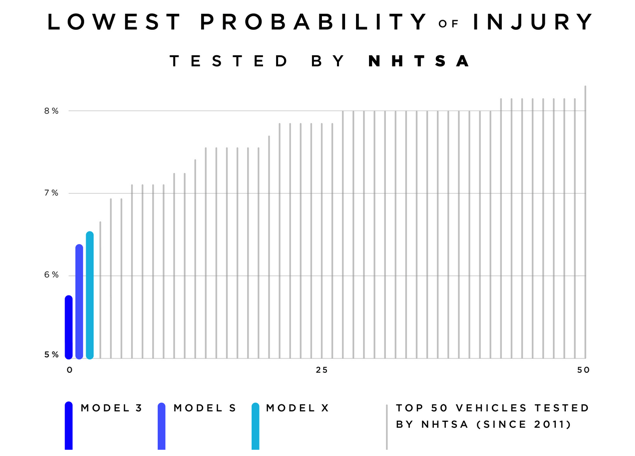
As seen on the above picture, Teslas are the SAFEST cars of ALL cars tested by NHTSA since 2011, pretty impressive for a startup.
In this article I will explain why Tesla's cars are the safest in the world, and why the primary reason for buying a car should be safety!
There are two parts of Tesla Safety:
- The Active part called Autopilot
- The Passive part - Body Structure
Let's dive deapper:
1.Tesla's Active Safety part or Autopilot
The only thing I want to mention here before letting the videos and Sandy Munro speak is that this Autopilot system is ALWAYS improving, today is better than yesterday, and is improving at an exponetial rate, which will lead to Full Self Driving and close to zero deaths and accidents, but we have to ensure the development is not stopped by some Luddite shorting the company's stock for finacial gain. Below is one of the largest collection of Tesla's Autopilot saving lives, which speak for themselves:
What experts say about Tesla Autopilot!
“With Tesla’s Autopilot being 8 times safer than the average driver & only being on the market for a few years, Sandy Munro believes it would be absolutely criminal to stop the progression & normalization of this technology in the market.” https://t.co/DNYhCNuyNW #Tesla @elonmusk pic.twitter.com/zlj5RTJHZ1
— Tesla New York (@TeslaNY) April 19, 2021
Tesla Saving Lives on Camera
by
Top Electric
Top 10 Tesla Autopilot Saves
by
WatchTop10s
Tesla Saves Lives!
by
VinnyCam
Tesla Autopilot Save Life Compilation
by
Sleek Tech
Tesla Autopilot Saves Compilation 2021
by
Top 5s Videos
Transfer Price
Here is some more information about this product that is only revealed once clicked on.
Tesla Autopilot Predicts Crash
by
Wham Baam Teslacam
Teslas Avoiding Accidents Compilation
by Nigel McGill
Top 10 Tesla Autopilot Saves
by
Elon's friend
Tesla 5-Star Crash Test Rating
by
Business Insider
Tesla Saves Lives Compilation 2021
by
Xethel
Tesla Autopilot Avoiding Crashes
by
Xethel
Tesla saved my life!
by
Michael Finley
Advertise here.
Featured image: tesla.com
2.Tesla's Passive safety part or the Body Structure
How did Tesla achive this? Let Elon being Elon and explain it best:
Simple explanation of polar moment of inertia & other important car terms at https://t.co/CftQ1v9YCL
— Elon Musk (@elonmusk) September 20, 2018
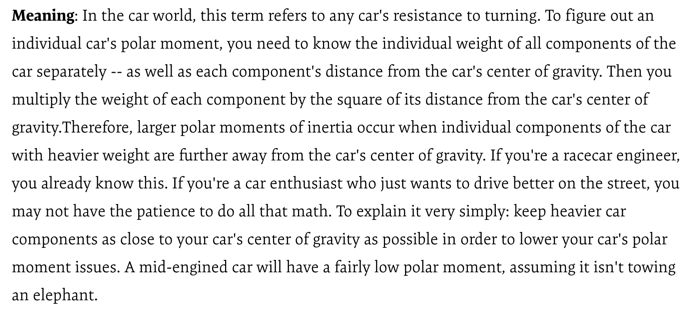
See below explanation of Polar Moment of Inertia from Complex.com site.
Now let's see some of Tesla's official explanation about safety below from Tesla:
Based on the advanced architecture of Model S and Model X, which were previously found by the National Highway Traffic Safety Administration (NHTSA) to have the lowest and second lowest probabilities of injury of all cars ever tested, we engineered Model 3 to be the safest car ever built. Now, not only has Model 3 achieved a perfect 5-star safety rating in every category and sub-category, but NHTSA’s tests also show that it has the lowest probability of injury of all cars the safety agency has ever tested.
NHTSA tested Model 3 Long Range Rear-Wheel Drive as part of its New Car Assessment Program, a series of crash tests used to calculate the likelihood of serious bodily injury for front, side and rollover crashes. The agency’s data shows that vehicle occupants are less likely to get seriously hurt in these types of crashes when in a Model 3 than in any other car. NHTSA’s previous tests of Model S and Model X still hold the record for the second and third lowest probabilities of injury, making Tesla vehicles the best ever rated by NHTSA. We expect similar results for other Model 3 variants, including our dual-motor vehicles, when they are rated.
What makes Model 3 safe?
In addition to its near 50/50 weight distribution, Model 3 was also designed with an extremely low polar moment of inertia, which means that its heaviest components are located closer to the car’s center of gravity. Even though Model 3 has no engine, its performance is similar to what’s described as a “mid-engine car” due to its centered battery pack (the heaviest component of the car) and the fact that Model 3’s rear motor is placed slightly in front of the rear axle rather than behind it. Not only does this architecture add to the overall agility and handling of the car, it also improves the capability of stability control by minimizing rotational kinetic energy.
Like Model S and Model X, Model 3 benefits from its all-electric architecture and powertrain design, which consists of a strong, rigid passenger compartment, fortified battery pack, and overall low center of gravity. These safety fundamentals help to prevent intrusion into the cabin and battery modules, reduce rollover risk, and distribute crash forces systematically away from the cabin – all while providing the foundation for our superior front crumple zone that is optimized to absorb energy and crush more efficiently. Here, you can see how the orange internal combustion engine block is thrust towards the cabin during a frontal impact test:
We also added state of the art features and new innovations in crash structure design, restraints and airbags, and battery safety to the core of Model 3’s design:
In frontal crashes, Model 3’s efficient front crumple zone carefully controls the deceleration of occupants, while its advanced restraint system complements this with pre-tensioners and load-limiters that keep occupants safely in place. Specially designed passenger airbags are shaped to protect an occupant’s head in angled or offset crashes, and active vents dynamically adjust the internal pressure of the frontal airbags to optimize protection based on the unique characteristics of the crash. Front and knee airbags and a collapsible steering column work to further reduce injury, all contributing to Model 3’s 5-star rating in frontal impact.
In pole impact crashes, in which a narrow obstruction impacts the car between the main crash rails, energy-absorbing lateral and diagonal beam structures work to mitigate the impact. This includes a high-strength aluminum bumper beam, a sway bar placed low and forward in the front of the car, cross-members at the front of the steel subframe that are connected to the main crash rails, and additional diagonal beams in the subframe that distribute energy back to the crash rails when they aren’t directly impacted. An ultra-high strength martensitic steel beam is also attached to the top of the front suspension to further absorb crash energy from severe impacts, and the rear part of the subframe is shaped like a “U” and buckles down when impacted. These structures continue to be effective even when a front motor is added for Model 3 Dual-Motor All-Wheel Drive, due to the fact that the subframe is designed to pull the nose of the motor down and out of the way.
Model 3 also has the lowest intrusion from side pole impact of any vehicle tested by NHTSA. Unlike frontal crashes, there is little room for crumple zone in a side impact, so we patented our own pillar structures and side sills to absorb as much energy as possible in a very short distance. These structures work alongside the vehicle’s rigid body and fortified battery architecture to further reduce and prevent compartment intrusion. With less intrusion into the cabin, our side airbags have more space to inflate and cushion the occupants inside.
Rollover accidents are a significant contributor to injuries and deaths on U.S. roads. Tesla’s vehicle architecture is fundamentally designed to have a very low center of gravity, which is accomplished by placing the heavy battery pack and electric motors as close to the ground as possible. In the event that a rollover does occur, our internal tests show that the Model 3 body structure can withstand roof-crush loads equivalent to more than four times its own weight and with very little structural deformation. NHTSA’s standards only require that cars withstand loads of three times their own weight.
Many companies try to build cars that perform well in crash tests, and every car company claims their vehicles are safe. But when a crash happens in real life, these test results show that if you are driving a Tesla, you have the best chance of avoiding serious injury.
Methodology
While NHTSA’s New Car Assessment Program doesn’t distinguish safety performance beyond its 5-star scale, every car rated by NHTSA since 2011 is assigned a Vehicle Safety Score, which NHTSA calculates by taking the weighted average of the Relative Risk Scores (RRS) in front, side and rollover crashes. We compared the underlying and publicly-available NHTSA data for each published vehicle since this calculation protocol began in 2011 (dockets: NHTSA-2010-0164, NHTSA-2011-0085, NHTSA-2012-0055, NHTSA-2013-0053, NHTSA-2014-0043, NHTSA-2015-0034, NHTSA-2016-0045, NHTSA-2017-0037).
The Vehicle Safety Score represents the “relative risk of injury with respect to a baseline of 15%,” according to NHTSA. Model 3 achieved a Vehicle Safety Score of 0.38, which is lower than any other vehicle rated in NHTSA’s public documents. By multiplying the Vehicle Safety Score by NHTSA’s 15% baseline figure, we arrived at an overall probability of injury for Model 3 of 5.7%. Applying the same calculation to each of the vehicles rated in NHTSA’s documents, we found that Model S achieved an overall probability of injury of 6.3%, and Model X achieved an overall probability of injury of 6.5%, making them the vehicles with the second and third lowest probabilities of injury, respectively, based on NHTSA’s publicly-available data and records.
We respect that NHTSA only endorses ratings from 1-5 stars so they can be helpful for the public to make quick and easy comparisons. The star ratings are especially helpful to show on the Monroney window stickers of new vehicles that are offered for sale. At the same time, we used NHTSA’s own methodology and data to help further educate the public about important safety information.
Now after reading so much theory, with regards to how safe Teslas are, let's see what happens in the real world, and hear from people who escaped death thanks to Tesla's safety features.
Just over a month ago I had a major car accident in my @Tesla by aqua plaining. Huge thanks to @elonmusk and his team for developing such a safe and strong car. It 100% saved my life, and managed to escape with just a few broken bones. pic.twitter.com/T1wPGWimua
— Chris Leonard (@chrisleonard23) January 12, 2021
Thank you @Tesla and @elonmusk for all 5 kids basically walking away from a horrific accident. #safestcar #bestthanksgivingever pic.twitter.com/SSQuIagvXq
— Michele Cardamone (@aspenphotog) November 27, 2018
Same thing for me. Look at the guy also involved in my accident and compare to my @Tesla #modelsp85 pic.twitter.com/KMBqGbtTYx
— Andrew Carroll, MD (@drcarroll) April 26, 2018
More photos below
— ⚡️特拉风🦔T☰SLA mania⚡️ (@Tesla__Mania) December 29, 2019
BTW this serious accident happened in Guangdong China.
Thanks to the hard work and brilliant design of @Tesla and @elonmusk, the Tesla driver seemed to have walked right out of the Model 3 unharmed. pic.twitter.com/xkQxOoao8G
My wife had this exact accident and she got out of the #model3 without any assistance. @Tesla makes incredibly safe cars. Car was totaled, but the wife was fine. Car was replaced with the exact same car (just a different color). pic.twitter.com/7zApL3I3ow
— reed (@PinballReed) June 27, 2019
As a result of an accident, a pillar fell on the roof of Tesla! But the roof of Tesla is so strong that the glass withstood and protected the passengers in the car.
— Eva CyberFox 🦊 (@EvaFoxU) September 30, 2019
Video: https://t.co/7lVEdTKC8y@Tesla @elonmusk pic.twitter.com/soTpV0qTqt
Wow... more photos from this Tesla accident. Safest vehicle 🙏🏻 This is absolutely devastating but the relief I have, seeing that this driver is alive and well, and still walking on the planet brings me happiness. Thank you @elonmusk & @Tesla for this vehicle. 🙏🏻♥️ @TeslaShawn pic.twitter.com/8jP72jZrQm
— jordan🚀 (@AstroJordy) September 24, 2020
Thanks @elonmusk and @Tesla for making such a great car. I used to think the crumple zone is just an advertising gimmick, until my first major accident yesterday.
— Kagai (@kagaikinyua) November 27, 2018
Walked away without a scratch and barely felt the impact. pic.twitter.com/vTG9BQ7yMO
Wife is walking away from a scary accident this morning thanks to @Tesla & @elonmusk. I’d have been concerned if it was any other car. Thank you for everything! pic.twitter.com/lN9KSmGVEf
— Sean A. Mason (@SeanAMason) June 18, 2018
I could carry on but I guess you get the idea by now.
Conclusion
If you care about yourself and your loved ones, you buy them a Tesla. You want to learn more about Tesla safety, go directly to https://www.tesla.com/VehicleSafetyReport, don't let the media BS fool you.
If you enjoyed the article, please share and spread the word as Tesla & Elon Musk are under constant attacks from powerful vested interests and the world needs to hear the truth.
Want to help my mission? Please consider contributing below, every tiny bit helps:
- Buy me a coffee on https://www.buymeacoffee.com/savedbytesla
- Buy me a coffee on https://ko-fi.com/savedbytesla
- Contribute on Patreon
- To advetise/promote your products/services you can contact us here savedbytesla@gmail.com
- To donate BTC 389pAPu2tc2SYUCRkGtrCte34mB1NStkxG
- To donate ETH 0x1071114df19b3f44ede3623b4d1c86181af37f7e
- To donate DOGE D8ww8NpdAuK6iRfUwNhTiFNBonntSaLjNy
- Use my affiliate links to help me produce more content: Sign up to Blockfi to earn interest on your crypto